‘ResearchED’: Building the Case for Learning Science, One Saturday a Time
The 74
Greg Toppo ·
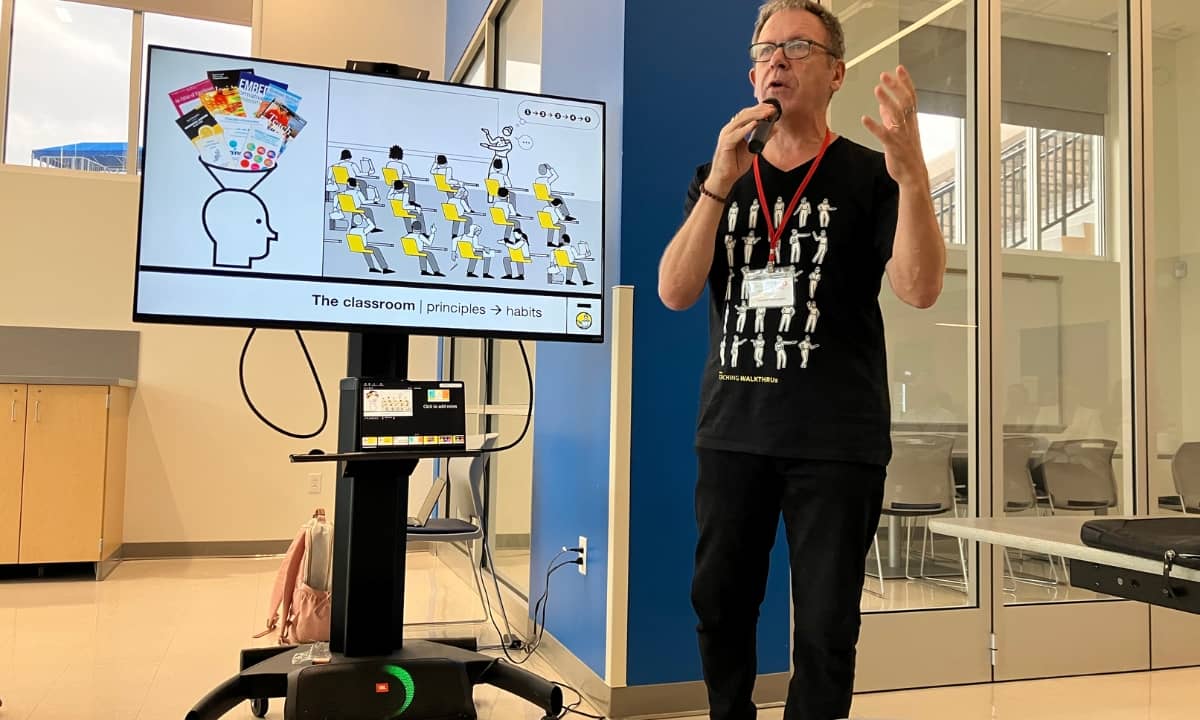
MAPLEWOOD, Mo. — At your typical education conference, the keynote speaker takes the stage with a big, flashy multimedia slide show and innovative ideas guaranteed to pump up the crowd. But on a recent Saturday morning, British teacher, blogger, author and consultant Tom Sherrington took a decidedly low-fi approach. He stood beside a modest-sized flatscreen
MAPLEWOOD, Mo. — At your typical education conference, the keynote speaker takes the stage with a big, flashy multimedia slide show and innovative ideas guaranteed to pump up the crowd.
But on a recent Saturday morning, British teacher, blogger, author and consultant Tom Sherrington took a decidedly low-fi approach. He stood beside a modest-sized flatscreen TV in a sunlit high school cafeteria and gave attendees a bit of a talking-to.
Get stories like this delivered straight to your inbox. Sign up for The 74 Newsletter
“We don’t need to do new stuff,” Sherrington told the crowd. “We need to do the things we know really, really well.”
This is ResearchED , a unique grassroots conference born at a southeast London independent school in 2013 that has grown into an international phenomenon — even if its U.S. version is taking its time getting established. The latest iteration, held at a public high school just outside St. Louis, was the first in the Midwest for ResearchED, which has sponsored events worldwide .
Each individual gathering remains small — the St. Louis conference saw just 160 attendees. But writ large it has become perhaps the single most effective way to convey to classroom teachers the science of learning, which studies how memory, attention and practice work, then uses that evidence to make teaching more effective.
The ideas on offer are straightforward, research-based and free of jargon, staying far, far away from culture-war controversies, gender issues or political fights. Just one session even mentioned artificial intelligence, and held it at arm’s length, suggesting ways to evaluate AI tools and choose those that embed the science of learning.
Think of it as back-to-basics with a bit of a British accent.
This particular Saturday, Sherrington, a longtime former teacher, stood in a black T-shirt, black jeans and black basketball sneakers, clicker in hand, taking the audience through a model geography lesson. The content didn’t much matter — it was all about the technique, a master class in how learning works via memorization, discussion and repetition. Then he pushed attendees to think about their own teaching and consider how well they’re engaging students.
It’s their “solemn duty” to get every kid participating in every class, he said. No exceptions, no excuses. “You need to think: ‘How do I run a classroom in which every child thinks he’s as important as everyone else?’ ”
Sherrington recalled that as a parent, the only time he’d been “properly cross” at a parent-teacher conference was when his daughter’s seventh-grade geography teacher told him the girl needed to make more of an effort to speak up in class.
“No!” Sherrington recalled telling the teacher. “That’s your job — not hers.”
A movement born on Twitter
Sherrington’s bracing talk fit well with the other 40 or so sessions at the one-day conference, which traces its roots to a key moment in British education: In 2012, U.K. teachers were discovering a lively online conversation taking shape on Twitter and teacher blogs, asking why they hadn’t learned how learning works in teacher prep programs.
One person who noticed was Tom Bennett , a teacher in London’s East End who by then was fed up with the unproven fads of the era, and with a profession that he felt too rarely used evidence to guide what it did.
Related ‘Cognitive Science,’ All the Rage in British Schools, Fails to Register in U.S.
In September 2013, Bennett and fellow teacher Hélène Galdin-O’Shea organized a one-day event at Dulwich College in south London. By Sherrington’s recollection, about 30 people — himself included — presented.
“At that point, we just thought it would be a one-off event,” he said in an interview. Writing on his blog afterward, he said the gathering “felt like the start of something.”
Another followed in 2014, and soon educators were asking for events in their own cities. A franchise model developed in which local organizers staged events under the ResearchED banner. They’re now so commonplace in England they’re typically never more than a 90-minute drive away.
International events followed, and ResearchED now spans the globe: the next three take place, respectively, in Toronto; Doha, Qatar; and Haninge, Sweden.
The irony that ResearchED is just now making it to the Midwest was not lost on attendees: Cognitive science is largely an American invention , with U.S. researchers doing much of the foundational work on memory, attention and learning. Yet the ideas have taken hold far more firmly in England , where policy changes in the early 2010s and a new framework for training early-career teachers pushed them into the mainstream.
Helen Reynolds , a British physics teacher now based in Tucson, Ariz., credits England’s push to embrace cognitive science with aiding its recent rise in international rankings. But she sees no comparable “mechanisms for improvement” in U.S. schools. “There are none.”
Organizers of the St. Louis gathering say they see it as a way to finally introduce teachers in the region to the findings.
“There is a whole science of learning out there that I wasn’t taught,” said MJ Mercanti-Anthony, a Bronx principal who has organized a handful of ResearchED events in New York City. During his session, he lamented how fads dominate much of the U.S. teaching profession, decrying “the multitude of wrongness in our field.”
The U.S., he said, is “easily 10 years behind” England and Australia in incorporating the science of learning into the classroom.
Cindy Nebel , a cognitive scientist who oversaw the St. Louis conference, put the gap closer to 15 years. Director of learning services at the Saint Louis University School of Medicine, Nebel co-founded The Learning Scientists , a group of cognitive psychologists who translate research on learning into blog posts, podcasts and downloadable materials for teachers.
Part of the problem is structural, she said, with state education departments typically dictating much of what teachers do in classrooms. “We give the power back to the states — it’s like we have 50 countries that need change, not one.”
Reynolds, the Arizona physics teacher, noted that English schools operate with a national curriculum and national testing, and teachers there are comfortable being told how to teach. In the U.S., by contrast, teacher autonomy “is sacrosanct.”
But she and others have found that resistance melts quickly: When another Brit, teacher and author Richard Wheadon , recently showed teachers in a nearby school district videos of English classrooms in which every student was engaged and thinking hard, he said, the teachers’ reaction was, “Why am I not doing that?”
‘A coalition of the willing’
ResearchED events are always one-day affairs, typically held in a school and always on a Saturday. Mercanti-Anthony, the Bronx principal, said the Saturday rule exists because ResearchED is meant to be “a coalition of the willing” — presenters and attendees are there because they want to be.
Tickets are dirt cheap, usually $60 to $80 — by contrast, a ticket to last summer’s four-day ISTE+ASCD conference ran from $595 to $795 . And speakers — in this case they came from 19 states and four countries — receive no honorarium, paying their own way. Sherrington, the keynote speaker, had his flight and lodging covered, but nothing more, aside from perhaps a few drinks at a post-conference karaoke session.
Related Why Schools Need a Phonics-Style Reckoning for Math
Nebel, the organizer, said the arrangement acts as a kind of quality-control filter. “Every talk is a passionate talk,” she said. It also typically means that attendees “walk away with things they can use Monday morning, instead of abstract theory or people who are trying to sell something.”
Every session must be approved by a local committee, though many ResearchED speakers who vie for a slot end up presenting at multiple conferences, creating a kind of mini lecture circuit for teachers who find a willing audience. In many cases, speakers end up meeting district leaders who hire them for paid workshops, book talks or consulting gigs.
Likewise, said attendee Jennifer Combest, a math coordinator for the Ferguson-Florissant School District in Missouri, the Saturday schedule shapes the crowd. “These are kind of like the nerdiest among us,” she said. “These are our most committed folks.”
From the audience to the podium
Above all, ResearchED’s most distinctive feature may be the way it turns attendees into presenters and, in a few cases, into authors and experts. Teachers show up, pick up a new idea, try it in their classrooms and then, months or years later, return to present about what happened.
Reynolds, the Arizona physics teacher, attended her first ResearchED while teaching in Oxford, England, and left with about 10 things she felt she could do differently the following Monday. Much of the value came between sessions, she said. “You just sat there [at] the coffee break and lunchtime, and you’d talk to the speakers.”
She eventually became a regular presenter herself.
For some, the cycle has changed their lives. At an early ResearchED, Sherrington gave a talk on the late education researcher Barak Rosenshine , whose work on principles of instruction he admired. After the talk, a publisher approached Sherrington and suggested he write it up. The result was a small book, 2019’s “ Rosenshine’s Principles in Action ,” which still sells briskly among teachers, especially in the U.K.
Patrice Bain, a longtime sixth-grade world history teacher in Columbia, Ill., has been focused on the science of learning for decades. Nearly 20 years ago, researchers from St. Louis’s Washington University studied her students, looking for evidence that ideas like retrieval practice, which asks students to regularly remember what they’ve learned, would work in classrooms like hers.
Related ‘Math Wars’: New York Wants To Reform Math Instruction, but Experts Disagree on How
As a teacher, Bain would give students frequent mini quizzes on 2-by-3-inch scraps of recycled paper, drawing five questions at random from material covered a day or a week earlier so students could test whether they really knew it. Too often in classrooms, she said, that retrieval step is missing.
Bain has since written or co-written several books, including 2024’s Powerful Teaching . St. Louis was her 14th ResearchED — she has spoken, among other places, in London, Dubai and Denver, and proudly wears conference lanyards from past events in a thick tangle around her neck. Teachers interested in cognitive science are often isolated in their own buildings. “ResearchED is those people,” she said. “It’s where you find your people.”
Indeed, among the presenters were a group of educators from the St. Vrain Valley school district in Colorado, who created a study group around Powerful Teaching and a science-focused team that now numbers hundreds of teachers.
Combest, the math coordinator in Ferguson-Florissant, said the event’s small scale was a big part of its appeal. Her district has a literacy initiative, and she has been wondering how to build a parallel one for math. A morning session offered by teachers working on the Kansas Math Project showed her that the idea already exists nearby.
Unlike national conferences with thousands of attendees, she said, ResearchED allowed her to follow up one-on-one with presenters and have deeper conversations grounded in research, a blend of theory and how ideas actually play out “in a classroom full of students.”
Related The Power of Handwriting: Improved Reading, Thinking, Memory and Learning
Source
The 74