What the phrase ‘Heritage American’ gets wrong
WBUR
WBUR ·
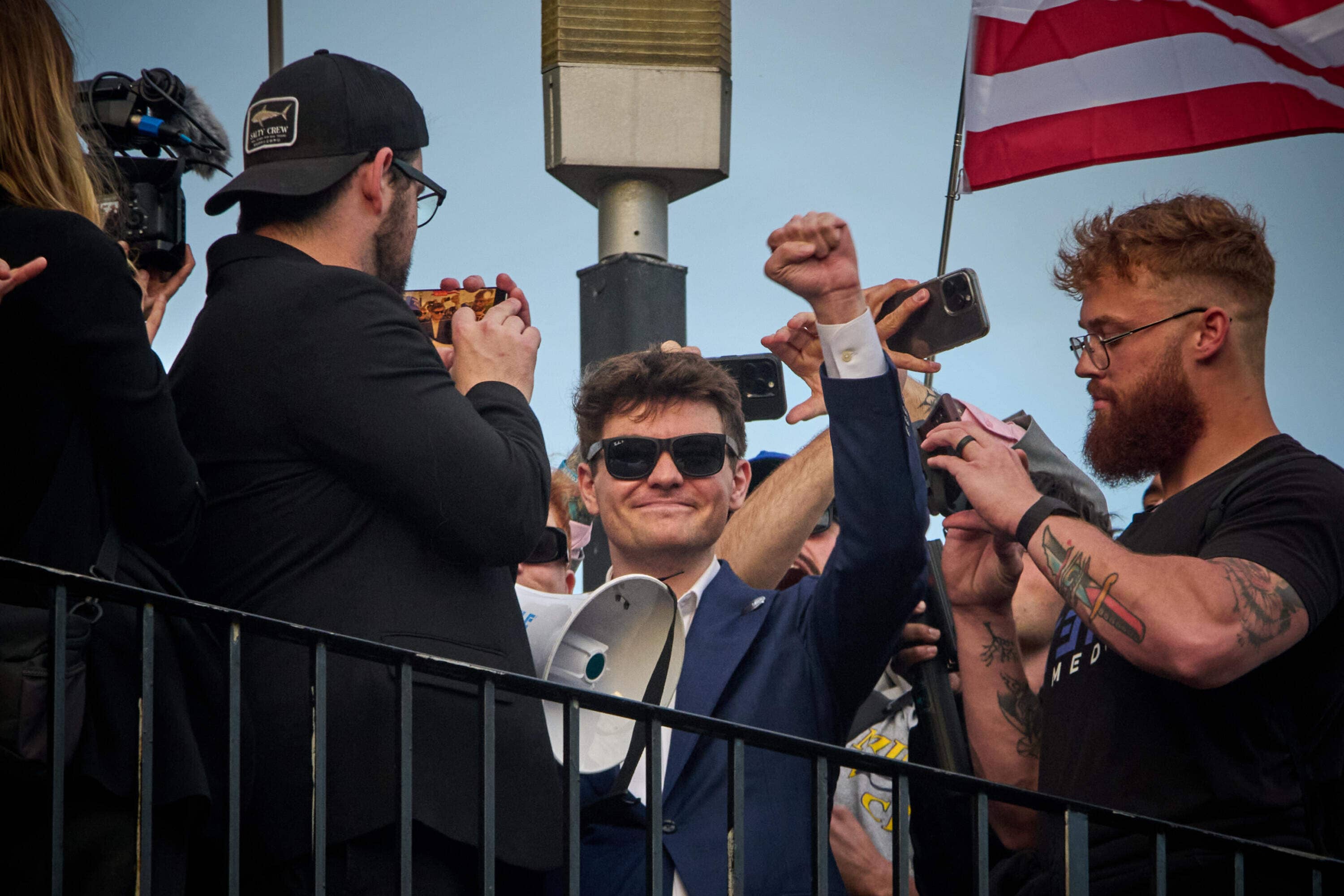
The phrase "Heritage Americans" invokes blood-and-soil nationalism and Christian supremacy. “If the impulse to take pride in ancestors who played a role in founding and building our nation is natural and legitimate — and I believe it is — that claim belongs to far more of us than Nick Fuentes and company would have you believe,” writes Andrew Getrear.
Support WBUR
Commentary
For almost 50 years, my family lived in a home that had been a family farm throughout the 19th century, in a Connecticut town settled in 1648. In 1776, George Washington rode his army right past where our house stands, past the blacksmith shop that was once next door, on his march from Cambridge to New York. I raised chickens in the barn that the Jennings family, the original owners of the property, built in the 1840s. I grew up knowing which chestnut trees the Bedford family, who also once lived there, planted in 1903. I spent hours in the burial ground down the road, reading the names of people who farmed that land in colonial times, fought in the Revolution and the Civil War and sailed as 19th-century sea captains. Their history became my history by virtue of proximity, imagination and the magic of being an American.
I imagine that if they were my actual ancestors, if my family had lived here for 200, 300, 400 years or even longer, I would feel even more connected to them, to the land, to this country. Which brings me to the "Heritage Americans" debate.
The term “Heritage Americans” surfaced online in 2025 within MAGA circles, and gained currency through JD Vance's Claremont Institute Statesmanship Award dinner speech and writers at American Reformer magazine . Vivek Ramaswamy traces its rise directly to Nick Fuentes, the far-right commentator and the Groypers who follow him. It involves a lot of blood and soil nationalism (an ideology that links a nation’s identity to a specific racial ancestry) with a dollop of Christian supremacy. I want no part of it.
But underneath the bigotry, I recognized something real and important that we all share: a deep emotional need to be connected to whoever came before us, and to whoever comes after.
One example of that need can be found in “ Finding Your Roots ”, the PBS documentary show that explores the ancestry of an eclectic mix of celebrities. There is a moment in almost every episode when the celebrity learns of an ancestor they never knew about and — instantly, involuntarily — becomes emotional. Tears are common. Because knowing and connecting to our personal history is important to the human psyche.
Underneath the bigotry, I recognized something real and important that we all share: a deep emotional need to be connected to whoever came before us, and to whoever comes after.
My own family has been here 136 years, seven generations. We’re proud Americans. Still, folks whose ancestors settled the wilderness, built our institutions, fought in the Revolution and Civil War (wars that defined our nation’s existence) are something special. It shouldn't be wrong to say so, as long as it's said in a way that doesn't diminish anyone else.
And that’s the problem with the current discourse. The criteria appear to include ancestral presence in this country from the colonial period through the Civil War — living, building, fighting and dying here between 1607 and 1865. But the current definition diminishes some groups of people and erases others altogether.
Native Americans and African American descendants of slavery can claim ancestry from that period as legitimately as anyone, and can claim to have built this country — not as metaphor, but literally. Without the assistance of Native Americans, the first European settlers would have quickly perished altogether, and the heroic contributions of Native Americans in the U.S. military is well known. This continent was theirs for tens of thousands of years before the rest of us even arrived. Aren’t they “Heritage Americans?”
Enslaved and free Black laborers quarried the stone, dug the foundations, and fired the bricks for the White House and the U.S. Capitol. Crispus Attucks was killed in the Boston Massacre in 1770, five years before Lexington and Concord, and is often considered the first casualty of the Revolution. Black soldiers fought in the Revolution, the War of 1812 and the Civil War. (In fact, the U.S. Colored Troops made up 10% of the Union army .) Their descendants are “Heritage Americans” by any standard.
The first Jews arrived in America in 1654 , landing in Dutch New Amsterdam. Jews were prominent in 18th-century colonial Charleston, a Jewish doctor practiced medicine in Colonial Williamsburg and Jews were among the earliest settlers of Savannah, Georgia. There was a Jewish cemetery in Philadelphia by 1740, and in 1790, Jews famously welcomed President George Washington to Touro Synagogue in Newport, Rhode Island, and received from him one of the most important letters on religious liberty in American history. Jews also fought in the Revolutionary War, the War of 1812 and both sides of the Civil War. Their descendants are also “Heritage Americans”.
If the impulse to take pride in ancestors who played a role in founding and building our nation is natural and legitimate — and I believe it is — that claim belongs to far more of us than Nick Fuentes and company would have you believe.
Why is this important? All Americans benefit from the presence of so-called “Heritage Americans," because unlike other nations, we're not connected by tribe, clan, blood, ancestry, religion or even language. We're connected by the values, institutions and history passed down to us by earlier generations of Americans, by Lincoln's " mystic chords of memory ." But it matters that some of our fellow citizens hold those as personal, inherited memories, passed directly from generation to generation. Memories carried that way have a humanity and intimacy of a different quality than what we can learn from a book or a Ken Burns documentary. When shared person to person, a portion of that intimacy transfers to us all.
If our disgust with the Groyper concept of “Heritage Americans” causes us to devalue heritage (the connection of the present to the past) and posterity (the connection of the present to the future), we will all lose something ineffable but vital. Society could become untethered, atomized and self-centered. This exclusionary concept is a mechanism for division, disunity and the deconstruction of a civilization it has taken centuries to build.
Too many Americans have worked too hard and sacrificed too much for us to let that happen. One hundred years from now, I hope any kid could lean against the old Jennings barn and imagine Washington marching by. That should be every American's heritage.
Source
WBUR