Women who fought back take center stage in ‘The Wash,’ ‘1972’ and ‘The Getaway Driver’
WBUR
WBUR ·
In three Boston-area productions, critic Jacquinn Sinclair sees true stories of strikers, abortion providers and an anti-war radical that show what it costs to fight for change.
Support WBUR
REVIEW
One step toward justice can launch a revolution.
Three productions now onstage — " The Wash ,” “ The Getaway Driver ” and “ 1972 ” — center on the collective power of women willing to fight for what they believe in.
In Front Porch Arts Collective’s beautiful production of Kelundra Smith’s “The Wash,” Black laundresses in Atlanta are tired of being paid in rice and beans, or not at all, for their backbreaking work. To fix it, they knock on customers’ doors to collect what they’re owed. But after many slammed doors and threats of violence, and with back taxes owed on the house they work from, the women change tactics.
The story is inspired by the Black washerwomen who in 1881 organized the Atlanta Washerwomen Society and went on strike to set fair wages and reform labor practices. Smith, a journalist and playwright, first learned of the story at the Smithsonian’s National Museum of African American History and Culture and was so struck by it that she decided to write a play.
Though the women in Smith’s script are fictional, the impact they represent is very real. Smith’s writing sings under Tasia A. Jones’ excellent direction, supported by Lindsey McWhorter’s artful choreography, Janie E. Howland’s scenic design and Pamela Hersch’s projections of swaying trees, stained glass and more. The mesmerizing cast includes MaConnia Chesser as Jeanie, MarHadoo Effeh as Thomasine, Eliza Fichter as Mozelle, McWhorter as Anna, Jada Saintlouis as Charity and Kiera Prusmack as Jewel. McWhorter’s Anna leads the charge as the strike’s chief organizer, and Chesser is in rare form as Jeanie, Anna’s best friend and chief skeptic. Chesser’s antics kept the crowd laughing throughout, and McWhorter was moving as Anna explaining that the group’s work isn’t just for them, but for everyone.
As the women — who mobilized thousands of strikers, including some white women — grow more powerful and successful in their fight, costume designer Marissa Wolf moves their clothing from more muted tones to full skirts in primary colors, and finally, bold African-print robes, jackets and skirts. The deliberate shift seems to nod to the enslaved African ancestors who toiled without pay long before these women, letting them know that this fight was for them too.
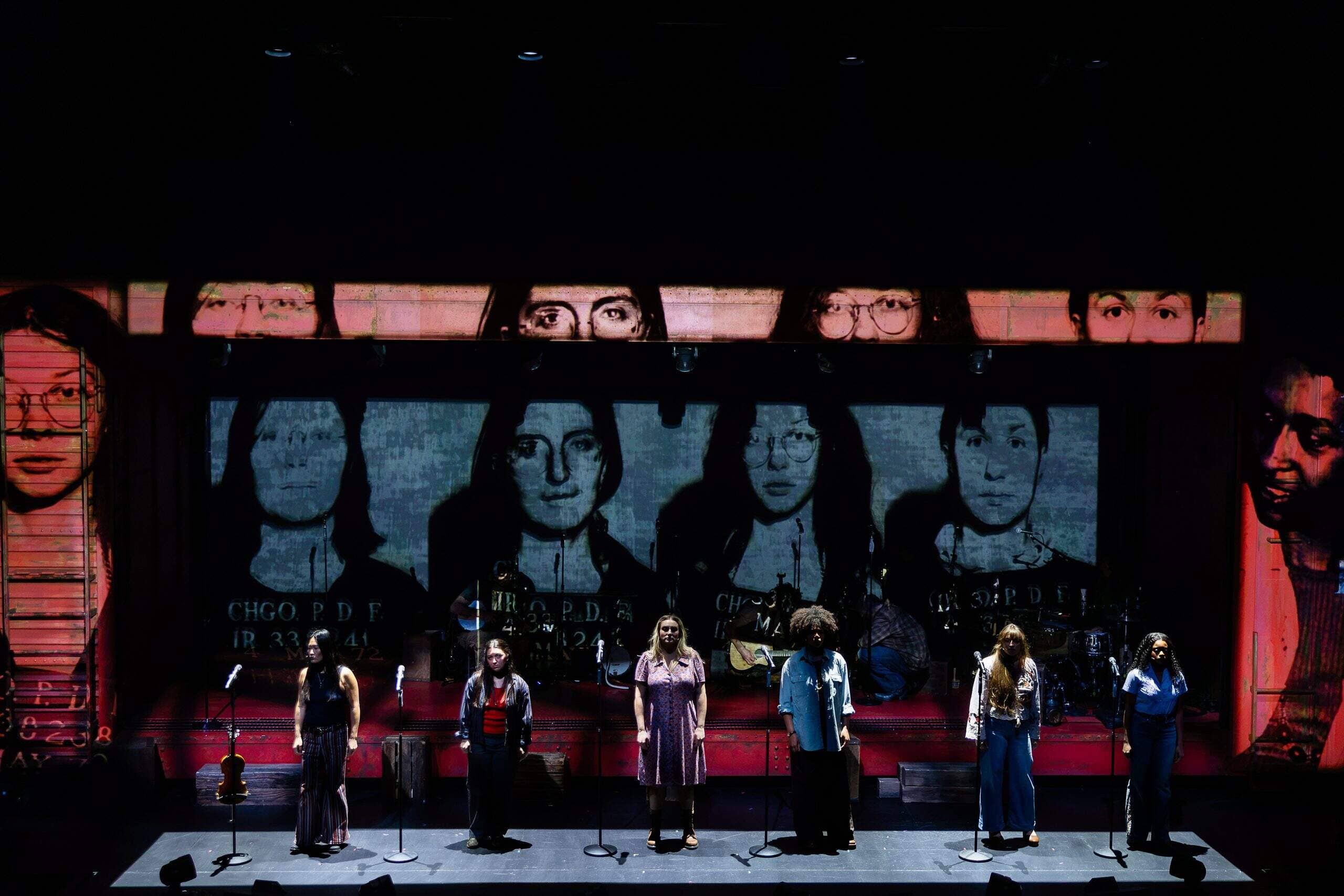
A battle for the power to choose anchors the American Repertory Theater’s spellbinding production of “1972,” a world-premiere musical with music and lyrics by Chadwick Stokes, of the Boston-based indie bands Dispatch and State Radio. Stokes wrote the book with Jessie Nelson, who also directs. In the show, Hannah (a stellar Gracie McGraw), 19 and pregnant, hops a train to escape an abusive relationship. Along the way, she makes friends and tries to decide what to do about the baby. But in 1972 abortion was illegal in most of the U.S. and an illegal procedure could land a woman in jail — or kill her. Hannah meets Louisa (a magnificent Jackera Davis), a preacher’s daughter who went through a harrowing experience trying to get an abortion.
The music in the show is excellent, and the songs (even the turn-off your cell phone song at the show’s start) are sung and played by about a dozen talented musicians and singers. There are drums, bass, harmonica, trumpet, the violin and more that help set the vibe and move the show along that’s set in a red-painted train caboose in front of gorgeous projections. Every single cast member sings throughout the show that introduces us to Hannah’s plight and the Janes, an organization of women who help women have safe abortions. Head Jane Harlan (a superb Khaila Wilcoxon), sings about their work, while introducing all of the other Jane heroines as they band together to help Hannah who is client 10,363.
The real-life Jane Collective reportedly performed 11,000 abortions between 1969 and 1973, when the Supreme Court’s Roe v. Wade decision legalized abortion nationwide.
In “The Getaway Driver,” protesting the Vietnam War lands Katherine Ann Power in a world of trouble. Central Square Theater’s production of the play by Deborah Salem Smith and Charlie Thurston mostly details the life of Power (Rebecca Gibel) and is based on the true story of Power and Clare Schroeder. A college-educated student from a stable home, Power joins a group of other passionate young people who opposed the Vietnam war. But after a bank robbery ends in the death of a police officer, the perpetrators’ worlds fall apart. Told largely through monologues by Gibel and Rachael Warren, who plays Clare, the daughter of the slain officer, the show features a set by An-Lin Dauber (who is also the costume designer) and video design by Peter Sasha Hurowitz. Much of the play traces Power’s downward spiral and Clare’s grief and desire for revenge. Though the premise for the show is an intriguing one, the emotional high stakes didn’t capture me until a tearful scene in which Power — who spent 23 years on the run , the longest of any woman in FBI most wanted history — stands before the parole board explaining herself. It made me pause to consider how quickly a life can turn upside down, and how hard it is to atone for it.
The Front Porch Art Collective’s production of “ The Wash ,” runs through Nov. 22 at Stanford Calderwood Pavilion at the BCA in the Roberts Studio Theatre. The American Repertory Theater’s “ 1972” runs through Dec. 6 at Farkas Hall in Harvard Square and Central Square Theater’s “ The Getaway Driver ” runs through Nov. 29.
Performing Arts
Source
WBUR