The Ala Wai And The Value Of An Idea That Didn’t Get Built
Honolulu Civil Beat
Douglas Murata ·
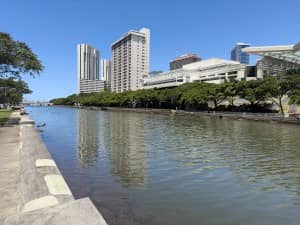
Cooling seawater was considered to add flow and help circulation and water quality.
Cooling seawater was considered to add flow and help circulation and water quality.
In his recent Civil Beat commentary, Amarjit Singh argues that the Ala Wai Canal needs more than floodwalls . Flood protection, water quality, sediment, aging canal walls and the canal’s single ocean outlet he writes, belong together as one integrated watershed challenge.
He also calls the Army Corps of Engineers flood-risk plan as “serious, data-driven and backed by extensive modeling.”
I agree with both points, and his piece reminded me of an idea I once worked on that never got built.
Ideas showcases stories, opinion and analysis about Hawaiʻi, from the state’s sharpest thinkers, to stretch our collective thinking about a problem or an issue. Email news@civilbeat.org to submit an idea or an essay.
More than 20 years ago, while working at the Honolulu Board of Water Supply, I was part of an effort to explore district cooling for Waikīkī. The concept borrowed from district heating systems in colder climates and turned them around.
Deep wells would draw naturally cold seawater from beneath the district and pass it through heat exchangers, to provide cooling for Waikīkī, reducing the need for individual air-conditioning systems in hotels and commercial buildings.
For the board, facing a prolonged drought at the time, an important goal was conserving potable water, a limited resource we could not afford to lose. Lower electricity use and lower peak demand were additional benefits.
There was another possible benefit. After cooling, the seawater might be discharged near the upper Ala Wai, adding flow that could help circulation and water quality, at the time, significant concerns as well.
It was a hope to be tested, not a vetted design. But it reflected the same instinct Singh describes: asking whether one intervention could serve several purposes at once.
The project ended after a test well showed that the water beneath Waikīkī was warmer than anticipated. The economics no longer worked.
Looking back, I don’t regard it as a failure. We often judge planning efforts by whether they were implemented, and by that standard an idea that never leaves the drawing board has failed.
But the purpose of planning is not to prove that our preferred solution is right. It is to find out whether it is.
A Learning Problem
The concept met real evidence, the evidence showed that a key assumption was wrong, and we learned that early and inexpensively, before committing to a full project.
I think that is worth remembering as we consider the Ala Wai. Big, complex projects carry assumptions about cost, performance, conditions and public priorities, and many of those assumptions are made years before anything is built.
Floodwalls may well be part of the answer, as Singh himself notes.
The more important question is how a plan is built to learn: what we are assuming, how we will find out if we are wrong, and who has the job of saying so.
That kind of capacity is less visible than concrete and pumps, but it may matter just as much. Resilience is not only an engineering problem. It is also a learning problem.
Singh’s article suggests the Ala Wai may be a case in point. The Army Corps of Engineers has studied the canal for more than two decades, and the debate still tends to center on floodwalls.
Singh asks us to move beyond that framing, to consider water quality, sediment, aging walls and a single outlet, and to weigh a billion-dollar investment against the cost of a catastrophic flood, not against doing nothing. When a problem persists this long and the argument keeps narrowing to one answer, that may be a signal the question itself has changed.
That calls for an upstream perspective. Floodwalls, pumps and dredging are technical responses, and they matter. But a problem that keeps outgrowing its solutions may also be an adaptive challenge, one that asks us to revisit our assumptions and, at times, change how we do things. Downstream, we argue about solutions: walls or no walls, this project or that one. Upstream, we ask what problem we are really solving and which of our original assumptions still hold.
The path forward for the Ala Wai may not lie in choosing among solutions, but in continuing to ask what problem we are really solving, testing what we believe about it, and staying open to the answer. The Ala Wai conversation needs to move upstream.
Editor’s note: Douglas Murata was the former chief strategic development officer for the Honolulu Board of Water Supply between 2003-2005 and oversaw the water resources and business development departments. District Cooling was one of its strategic initiatives, among others.
--> Sign up for our FREE morning newsletter and face each day more informed. -->
Sorry. That's an invalid e-mail.
Thanks! We'll send you a confirmation e-mail shortly.
Local reporting when you need it most
Support timely, accurate, independent journalism.
Honolulu Civil Beat is a nonprofit organization, and your donation helps us produce local reporting that serves all of Hawaii.
Contribute
Source
Honolulu Civil Beat