Months of congressional redistricting fights end with apparent Question 3 win
Maryland Matters
Bryan P. Sears ·
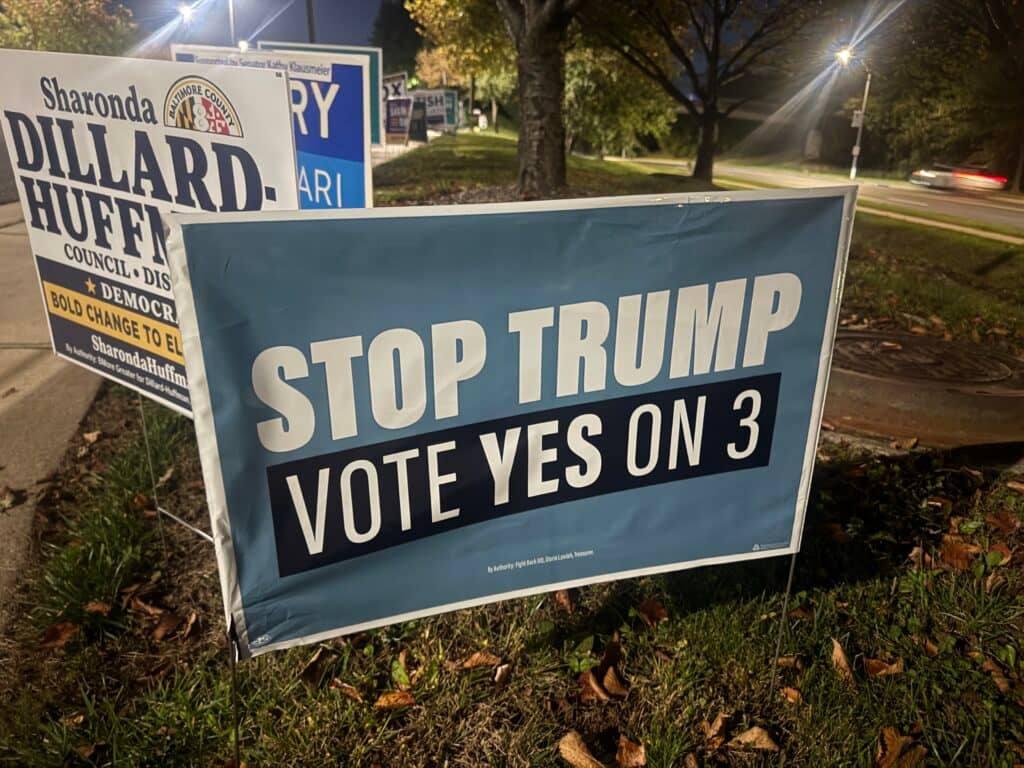
Question 3, the proposed constitutional amendment that would change the way Maryland congressional districts, appeared headed to passage Tuesday, with 60% of voters supporting it in early returns, capping months of fighting on the issue.
A Democrat-backed proposal in a Democratic state that was framed as a rebuke to President Donald Trump should have been a slam-dunk, but the fate of Question 3 was still up in the air when polls opened Tuesday.
As returns started rolling in, however, it became clear that Question 3 was headed to an easy passage. In unofficial returns, a little less than 1.1 million people had voted for the constitutional amendment that could open the door to new congressional maps as early as next year, while 717,646 had voted against it.
It was the most contested and most high-profile of three ballot questions — all three were winning by comfortable margins in unofficial results — put before voters Tuesday, and one that Gov. Wes Moore had a large stake in.
“For more than a year, I’ve been clear: If other states were going to redraw their congressional maps in the middle of the decade, Maryland should be part of that conversation,” Moore said Tuesday night. “My position has not changed. Donald Trump does not get to rewrite the rules for his allies and then tell Maryland to sit on its hands.
“I am proud that the people of Maryland used their power to push back by approving Question 3,” he said.
Passage of Question 3 establishes that there are no criteria in the state constitution or Declaration of Rights for congressional redistricting. The change would all but eliminate the ability of voters to challenge future maps at the state level.
Gov. Wes Moore headed to reelection win in rematch with Republican Dan Cox
The ballot question was passed during a two-day special session of the General Assembly in August. It was immediately the subject of separate court challenges in two counties.
Judges in Anne Arundel and Dorchester found the question as written by the Democratic legislative super-majority was vague and insufficient.
The Maryland Supreme Court largely agreed with those findings but opted to overturn orders striking the question from the ballot and instead re-wrote the question — though it did little to make the effects of a vote on the issue clear, as polls showed voters were confused by the ballot language.
Passage of the amendment has been a priority for Gov. Wes Moore, who has called for new congressional maps for more than a year. Moore and others in his party see the amendment as a response to hyperpartisan redistricting in other states. They’ve branded passage as a way to stand up to Republican President Donald Trump.
Republican leaders have said supporting the question on congressional redistricting would take away their voice in the state.
Currently, Democrats hold seven of the eight congressional races. Democrats would like to redraw the districts to make it harder for Rep. Andy Harris, the lone Republican, to remain in Congress. Harris represents the 1st District, which covers the Eastern Shore and reaches into eastern Baltimore County.
Even if the amendment passes, new districts would not be in place before the 2028 election at the same time Trump is finishing his second and final term.
Rashena Draughn, 44, who cast her ballot Tuesday morning at Maya Angelou French Immersion School in Prince George’s County, voted yes on Question 3.
“We have to fight fire with fire, said Draughn, a ninth-grade English teacher who moved to Prince George’s about three years ago from nearby Fairfax, Virginia. “The Republicans are not afraid to toe that line…. I think that the Democrats, for what it’s worth, should be able to respond in kind.”
In Baltimore, resident Kenneth Allen, 39, said he voted for Democrats, but opted to vote against Question 3. He said he has fears about unintended consequences that could harm Democrats if the maps are redrawn with the intent of unseating Harris.
Allen cited analysis showing that the GOP’s attempt to redraw districts in Texas and Florida could backfire , and voters could unseat Republicans in altered districts.
YOU MAKE OUR WORK POSSIBLE.
SUPPORT
“They made these maps based off of the 2024 election, and they made some assumptions that they shouldn’t have made. And I don’t want us to go down that same [path],” Allen said.
And if Democrats take control of Congress, as many national polls suggest, that could “put a check on the current administration,” meaning redrawing Maryland’s maps could be moot.
“I don’t think there’s a reason to take away anybody’s representation,” Allen said. “Western Maryland and the Eastern Shore — give them their representatives, you know?”
Voters also appeared to give big wins to the two other questions on the ballot:
Question 1 asks voters to approve a change to the state constitution that would require binding arbitration between state government and unions that represent state employees. It was leading with 75% of voters supporting it to 24% opposing.
Question 2 would amend the state constitution to allow the governor to make temporary appointments to the 11-member Commission on Judicial Disabilities in the event of a recusal, disqualification or vacancy because of an expired term. It was leading by a 67-33% margin in unofficial returns.
Despite being lower profile issues than Question 3, there was little voter drop-off in interest for the two measures, with just over 1.7 million voting on each.
Jack Hughes, the president of the American Federation of State, County and Municipal Employees Council 3, called the apparent passage of Question 1 “a win not only for state employees but for Marylanders who count on the services AFSCME members provide.”
“AFSCME members have worked tirelessly to pass this legislation,” he said. “Now, regardless of the administration, state employees will get the respect and resources they deserve.”
— Maryland Matters reporters William J. Ford and Christine Condon contributed to this story.
Source
Maryland Matters